We run the furnace, not just the printer.
Most ceramic printing failures happen after the build finishes. Debinding cracks the part, the furnace cycle drifts, and shrinkage lands outside tolerance. We own every step between the slurry and the shipping box, which is the only way to hold a number.
How we work.
Three commitments that decide whether a job is worth taking.
Quote
Every quote comes with a risk note: where the walls are too thin, where the shrinkage will bite, what we would change. If the geometry will not survive debinding, we say so before you pay for it.
Control
15 to 20% linear is too much variation to ignore and too consistent to treat as scrap. We scale the build file per geometry and correct against the measured first article.
Repeat
Once a geometry is qualified we lock the parameter set. Powder lot, slurry batch and furnace cycle stay on file against your order number so the hundredth part matches the first.
What leaves the building.
Quality control here is not a certificate on the wall. It is four things that happen on every new geometry, whether or not anyone asks.
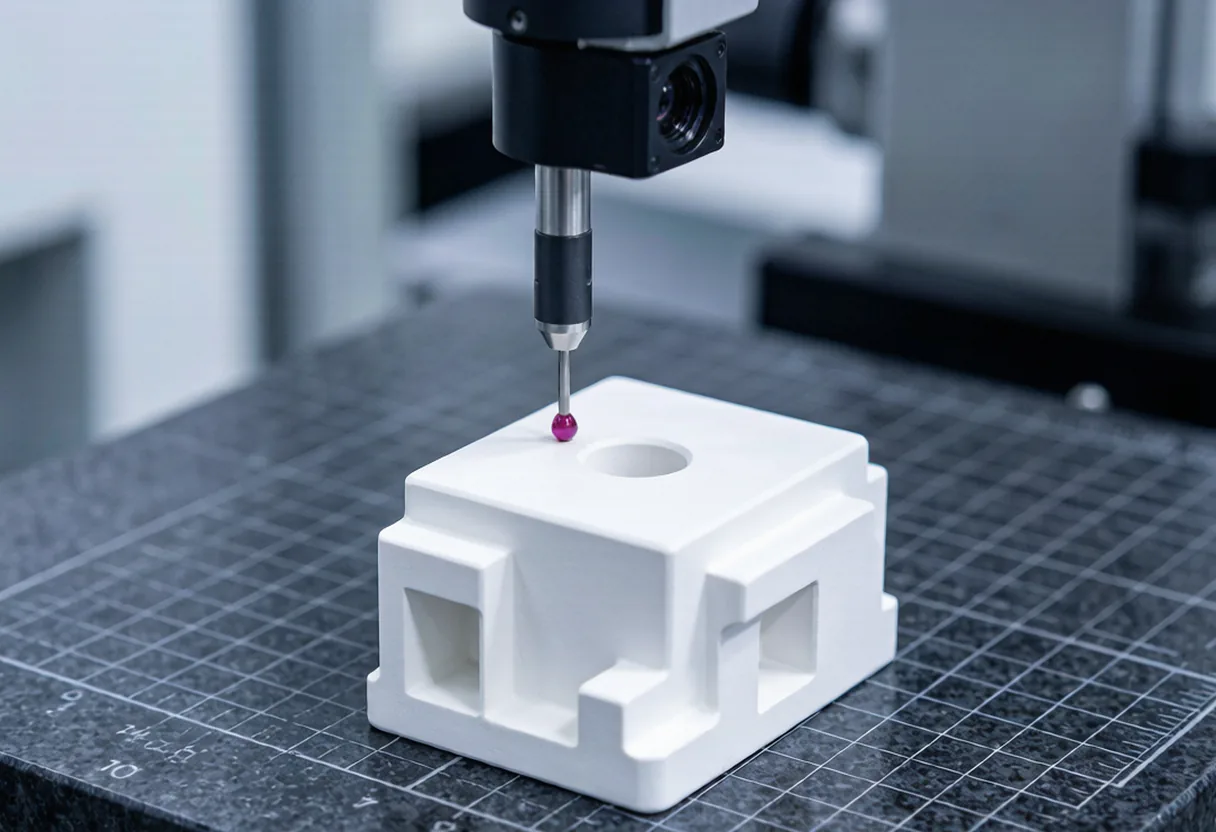
Measured against your drawing, shipped with the first article before the batch runs.
Archimedes measurement on sintered test bodies from the same furnace cycle.
CT scanning where a blocked or undersized passage would fail the part in service.
Powder lot, slurry batch, debind ramp and sinter profile kept against the order number.
Start with one part.
Send a single geometry and we will prove the process on it before you commit to a batch. Most customers come back with the second one.
Quoted within two business days.