Hollow turbine blades and complex internal passages are usually made by investment casting around a ceramic core. CoreCera SC is a silica-based grade we print by LCM, leach after casting, and remove without damaging the metal part.
Why cores matter in investment casting
Investment casting of superalloy turbine blades depends on a core that defines the internal cooling channels. The core must be strong enough to survive metal pour, chemically inert to the alloy, and weak enough to leach out afterwards. Traditional cores are injection-moulded from silica or alumina-silica blends, which requires expensive tooling and limits geometry.
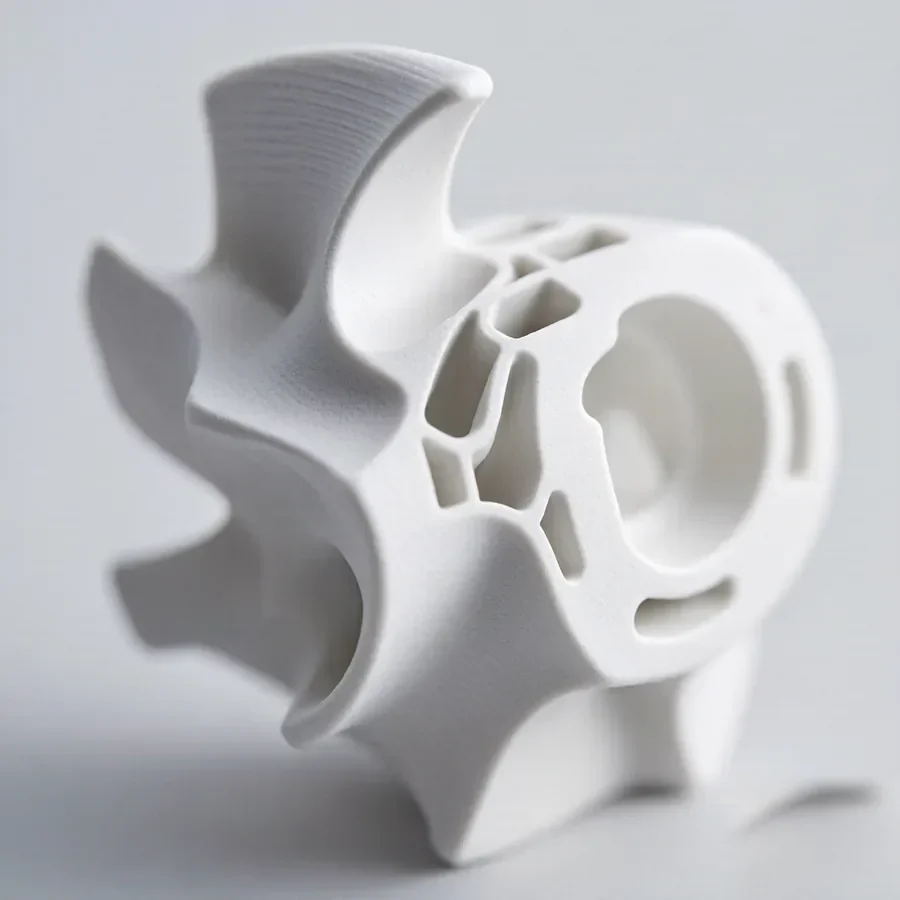
CoreCera SC removes that tooling constraint. We print the core directly from a CAD file, so internal passages can be curved, branching, conformal and sized independently of draft or mould-parting lines. The same digital workflow also makes design iteration fast: a new core geometry is just a file change.
CoreCera SC material design
CoreCera SC is formulated for two competing requirements. During sintering, it must develop enough strength to handle molten metal pressure and thermal shock. After casting, it must dissolve in a weak leaching solution without attacking the alloy. We achieve this by controlling particle packing and glass-phase content so the core sinters to a porous but rigid network.
The printed green core shrinks like our oxide ceramics, but the final density target is lower because the core needs permeable porosity. We characterise leach rate, hot strength and thermal expansion for each batch before shipping cores to the foundry.
Designing for the foundry workflow
Designing a printed core is different from designing the finished blade. The core defines the negative space inside the blade. We need clearance for metal shrinkage, venting paths for leaching solution, and sometimes tabs that the foundry can grip during dipping and pour. Wall thickness of the core itself is usually 1 to 3 mm, depending on the size of the blade and the metal pressure during casting.
After metal solidifies, the casting is placed in an autoclave or chemical bath. CoreCera SC dissolves over hours to days, depending on core mass and solution chemistry. The remaining metal shell contains the desired internal geometry with no tool marks and no parting lines.
Applications beyond aerospace
CoreCera SC is not limited to turbine blades. Any hollow investment casting with complex internal passages can benefit: pump impellers, heat exchanger headers, valve bodies and medical implants. The economics become attractive when the alternative is multiple machined sections welded together, or when design iteration speed matters more than unit cost.
If you have a casting application, send us the internal-channel CAD and the alloy. We will recommend core orientation, leaching access and the minimum core section needed to survive the pour.