CoreCera 3Y, CoreCera 999 and CoreCera ATZ are all oxide ceramics, but their mechanical and thermal behaviour are different enough that material selection often decides whether a part survives in service.
CoreCera 3Y: toughness first
CoreCera 3Y is a 3 mol% yttria-stabilised tetragonal zirconia polycrystal, or 3Y-TZP. The yttria stabilises the tetragonal phase at room temperature, and the fine grain structure allows stress-induced transformation toughening. In simple terms, a crack that starts in 3Y-TZP triggers a local phase change that absorbs energy and slows the crack down.
This makes CoreCera 3Y the best choice for parts that see impact, cyclic loading or fine features that must survive handling. Dental copings, ceramic bearings, cutting inserts and precision nozzles are typical applications. The material also prints with very fine detail thanks to its small particle size.
CoreCera 999: hardness and heat
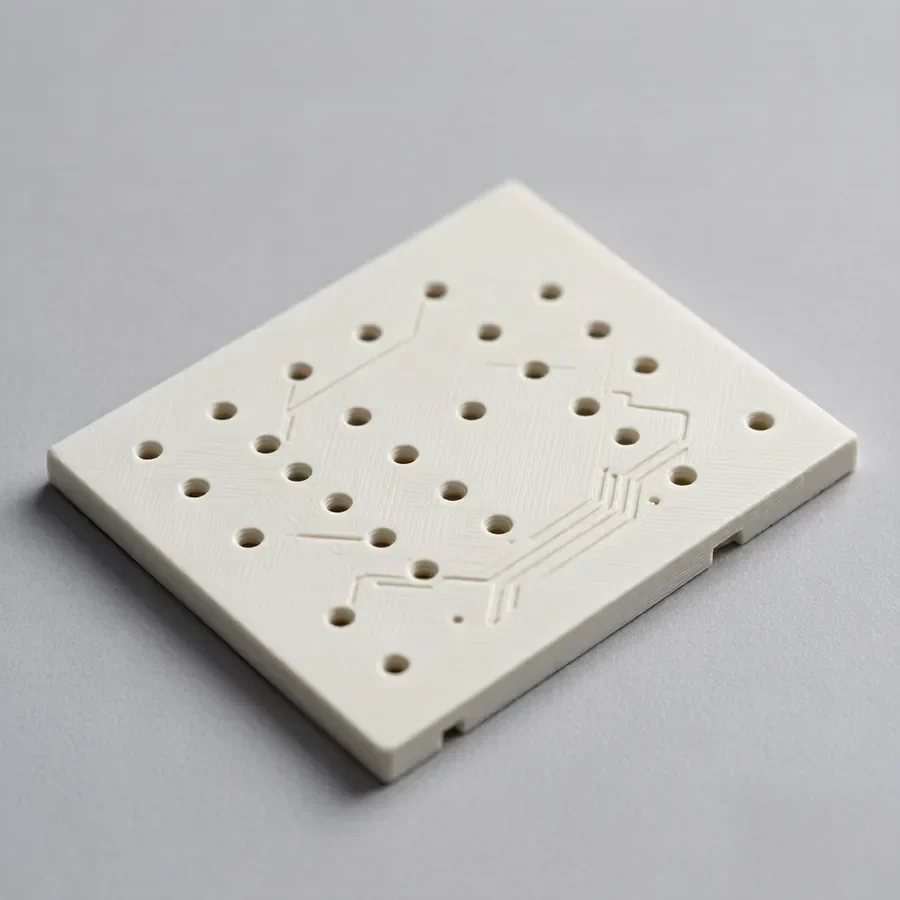
CoreCera 999 is a high-purity alumina, nominally 99.9 percent Al₂O₃. It is harder, stiffer and more thermally stable than zirconia. It is also an excellent electrical insulator and has good chemical resistance. The trade-off is lower fracture toughness and a slight penalty in fine-feature resolution because alumina particles are coarser than zirconia particles.
We use CoreCera 999 for substrates, feedthroughs, refractory fixtures, pump seals and parts that operate above 1000 °C. It is the right choice when the job is about hardness, dielectric strength or thermal shock rather than impact resistance.
CoreCera 998 and ATZ: the middle ground
CoreCera 998 is a slightly lower purity alumina that still offers excellent properties at a lower cost than 999. It is a good compromise for larger parts or applications where ultimate purity is not required. CoreCera ATZ is an alumina-toughened zirconia composite. It keeps much of zirconia's toughness while adding alumina's hardness and thermal conductivity. It is a strong candidate for wear parts and metal-forming tooling.
When we review a quote, we look at operating temperature, loading mode, electrical requirements, surface finish needs and chemical environment. The material recommendation is almost always one of these four grades unless the application specifically needs a leachable silica core.
Selection by service conditions
Both alumina and zirconia reach roughly 99.4 percent of theoretical density after sintering. Both can hold a ±40 µm tolerance on suitable geometry. Surface finish is typically 0.3 to 0.9 µm Ra as-sintered. The real difference is how the part behaves after it leaves our facility. A tough zirconia part might survive a drop test that would chip an alumina part. An alumina part might survive a thermal cycle that would degrade zirconia's stabiliser.
If you are unsure, send us the operating conditions in the quote form. We flag the grade that matches temperature, load, medium and dimensional requirements, and we note any design changes that would improve the outcome.